Sunday, April 11, 2010

Making Posts

This is a photo of Day 2 of what will be 4 days of log milling here on our Farm. This winter/spring project is intended to provide the materials for several fencing jobs this coming season.

A local builder with a portable Woodmizer saw mill, Jeff Peister, has come to the farm to saw up some trees we have logged. Locust was logged for use as posts because of its longevtiy and toughness, and Oak was logged for the planks. 
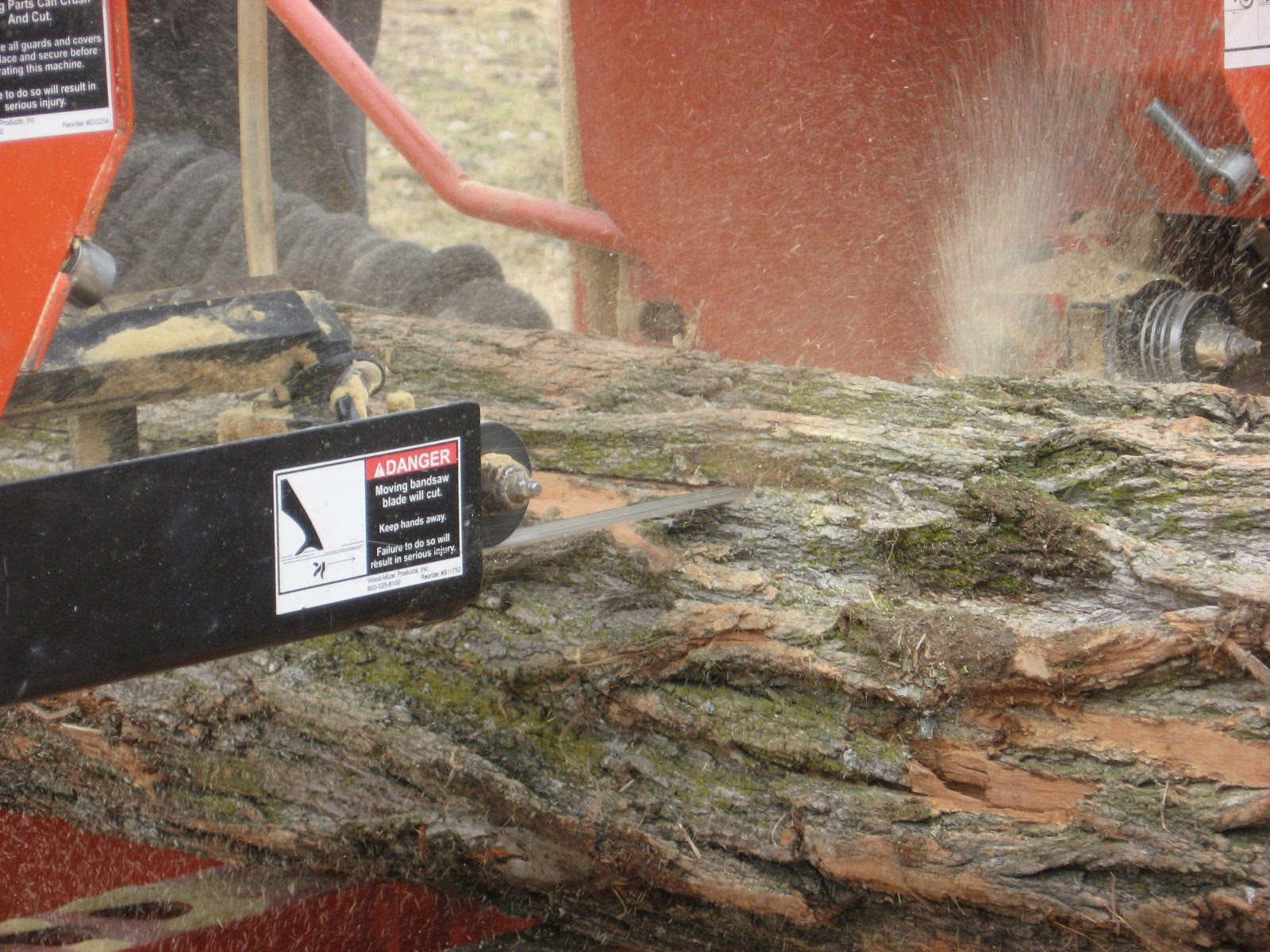


 After the log is lifted (with the help of our tractor) onto the cutting platform, the bark is removed with the first cuts.
 
After each cut the log is rolled and cut again.  The resulting wood is called slab wood, we  think it could make a nice fence for our pig pen.....Connely, who just turned 6, will undoubtedly dream up all sorts of great building projects for these rejected slabs.          
After the bark is removed the locust posts are cut...depending upon the size of the heartwood, we get 2, 4, or more 3 x 3 inch posts.
We plan on using these posts to fence in our 25 acre pasture up on route 217.  The pasture will be for the cows as well as the horses.
Below you can see the pile of posts growing...in front of the 3 x 3 posts are 1 x 1 oak "stickers".  The stickers are used to space out the posts so that they dry evenly and do not warp.
The next milling session will be to create more of the oak boards that you can see below.  They will be the top line of the fence.
We have cut 375 locust posts, they will support about 3/4's of a mile of fencing around the open portions of the field.  The remaining fence line will be high tensile going through tree lines surrounding the field. 

Friday, April 9, 2010

New Construction

We are rested and ready for the growing season and hopefully with a little help, I can get back into a regular "blogging" of all that is going on here...there is so much going on, that it is hard to know where to start.


Soooo...we will start with our new barn.


After having spent a good part of the 2009 season trying to sell our herd of cows, we had a change of heart.
We did not want to split the herd, and we wanted them to end up at the right place, so...we came full circle and decided not to sell.
You may wonder why we wanted to sell them in the first place???

We are vegetable farmers first and foremost. The cows help us to manage the land that is not suitable for vegetable production, and they are beautiful to look at grazing the verdant pastures at sunset; but when they get out of their pastures and are running over neghbors heirloom lawn balls, or tramping through the neighbors alfalfa field in the middle of our busiest time of year...well, Chris was ready to throw in the towel.."What are we doing this for?", "Do we even make any money on this beef operation?" "Wouldn't it be nice to only grow vegetables. imagine how much better we would be at it if that was really all that we did." These are all words straight from my husbands mouth, during the height of the season


The answers to many of the questions left little reason to keep them, no they do not make us a lot of money, yes, it would be nice to focus on only the vegetable production, but the answer to"What we are doing this for?" brought us slowly to the realization that we could not let them go.


Diversity is good for land, for the economy, for our diets.


Our farm is a diverse landscape of hills, lowlands, water ways, gravel and trees. Keeping this diversity in balance is our job.

Our farm business is heavily slanted toward vegetable production (albeit mixed vegetables) and selling beef and plants supports the vegetable operation while giving us added income.

We like to eat meat that has been raised here on our farm. As a former vegetarian, I only started eating meat when we began raising it.

And so the beef herd stays, in their new barn with their automatic waterer and when the grass greens up they will wander up the hill to graze to their hearts content.
The new barn is the beginning of a long term vision of more efficient and permanent systems. With better infrastructure and sytems we look forward to many more years of certified organic grassfed beef here on our farm.!!!!

Saturday, August 1, 2009

The Great Flood of 2009

The Ockawamack Creek flowed over it's banks and through the fields in ways that it has never flowed before.
The wheat is just barely above water here...some of it is now covered in silt and laying down flat...we have never combined compromised wheat like this...if we can get some dry days we will have to see what we can get off these seedings.

As the town of Claverack declared a state of emergency, our fields were filling and draining having soil removed and also deposited...while the rain continued.
The aftermath of flooding is not only soil erosion, but soil/silt deposits. Sometimes not a bad thing ...unless it is on top of a crop you are hoping to harvest.

Below you can see some very unhappy rows of soybeans, mesclun and arugula, swiss chard and beets...they are now known as the lost plantings....

Our five acre field has been fallow this summer being harrowed to kill weeds. It is always risky to leave a field open to the elements and it is the exception rather than the rule for us to not seed down open ground fairly quickly to protect it from erosion....hopefully we did not lose too much soil to the stream

Standing water has now been in the celery and celeriac for a few days...we will see how they survive.
Deep mud at the ends of the winter squash rows.


We have never seen water up this high....to the left is one of two entrances into our lower field, this bridge/water had to be crossed to harvest the potatoes for our end of the week deliveries.

Fortunately our new greenhouse did not float down stream.....there is normally about 50 feet between the stream and our greenhouse.
Fortunately less than 1/3 of our vegetable ground is in these lower fields. Only the fields pictured had standing and running water, all of our other fields are well drained and we are thankful for the diversity of terrain here on our farm. Though everything is water logged, the other crops are hanging in there and waiting for the summer sun and warmth to come.


Thursday, July 30, 2009

Video Footage from our flooded Fields

Chris took a drive out to the fields this morning, he starts out driving over the bridge...all that water is over the bridge...Then you can see the wheat and rye , or rather you can see water...the wheat and rye are under it...Fortunately most of our vegetable ground is not under water. A few crops we are worried about are the celery, celeriac and leeks. They are still under water as of this evening and we are expecting another inch of rain tomorrow...so it does not look like they will be getting dry any time soon. Our experience is that after 24 hours of submersion most vegetables suffocate and start to rot...we will see.

You can see in another view of the lower fields how hairy it was getting out to the potatoes to dig...after an entire night of steady rain (about 6 inches). Please disregard the amateur filming...It is hard to drive and keep on the road with a camera in your hand.

More photos to come...hopefully the rain will stop.

Wednesday, July 29, 2009

Garlic is in!!!

Tha garlic was harvested a week ago. We have three trailer loads in our pole barn curing. After the tops dry down we will trim it and then once the wrappers are thouroughly dry we will trim the roots and grade it. We save the largest for replanting in the fall and sell and distribute the other sizes.
Though we harvest the garlic scapes for early season eating...a few slip through cracks. The kids and I thought that it was interesting to see the various stages of garlic scape development...so we lined them up for all to see. The scape which is the seed head, gets larger as the bulbils (seeds) swell. Eventually the outer casing of the garlic scape "flowers" releasing the bulbils. We do not plant the bulbils as they would take a full year and a half to become a head of garlic...we plant cloves in November and harvest full heads in July. Less weeding!!!!
One benefit of all this rain is that instead of having to hook up our bed lifter to harvest the garlic, or use a garden forks, we were able to pull it instead. Faster and easier.
Thankfully there is something good about all this rain.


Wednesday, July 15, 2009

Mourning tomatoes

Last Friday we started picking cherry tomatoes. They are always the earliest, and always provide a glimpse of what is to come.
On Sunday night Chris and I pulled out the Compendium on tomato diseases, we were concerned about some yellowing on the lower leaves, we figured early blight...but wanted to be sure.
On Monday morning I went for early morning walk with my sister-in-law......I wanted to inspect the tomatoes more closely, there it was, as sure as could be the tell tale signs of late blight.
Yes, the blackened lesions around the stem, the gray spots on the leaves. Monday afternoon Chuck Bornt our extension agent confirmed it as late blight. We spoke with him yesterday and he has confirmed seven more cases in our area. Two days later some plants were pretty devastated, while others were still green.
In this picture below you can see the area/variety that was the most affected, brown amidst some green. We are in the process of pulling all of the heavily affected plants, saving the green ones. A chemical salesman came to the farm today, the first we have ever met. He came to bring us the Certified Organic Copper that we will be spraying on the still green plants and on our second planting which is still looking green.
We have very mixed feelings about copper, about spraying in general, we tend to be Luddites in this area, we don't tend to even spray the organic sprays. But the dilemma is that we have put a lot of work into these plants, they are among the earliest seeded in the green house, they are then transplanted into larger cell trays, they are then transplanted onto black plastic outside, they are then trellised each week to keep them from falling over. Hours and hours of labor. And trying to save them will be hours and hours more labor....so, is it worth it??? Of course it is if we get tomatoes.
There is no guarantee that pulling and spraying will even work, late blight is a persistent disease under the right conditions. It destroyed the Irish Potato Crop in the mid 1800's causing the Potato Famine.
This has been the perfect season for late blight. Wet and cold. And even now though the sun is shining, the nights were cold leaving a heavy dew...more moisture providing perfect breeding grounds for the late blight spores to spread.
Forward we move, we spent the first hours of realization feeling sick to our stomachs, the next morning we accepted complete loss, by the next afternoon we felt we should be proactive and try to at least save the second planting. So in some sick way things are looking up. Other crops look superb, the garlic is large and white and abundant, the purple carrots we will be harvesting in the next months are gorgeous and beans are sweet and crisp...time will tell for the tomatoes...we will keep you updated.


Thursday, July 9, 2009

Purchasing Grass Fed Organic Beef

We are excited to be able to offer beef to our members in the city and offer everyone the convenience of paying by credit card online. The wonders of technology.... Truly transforming our communication every day.

We have an updated availability list on our Blog, check it out to see what we have for the week.

E-mail us an order, remembering to tell us when and where you would like to pick it up.

We will put the order together and e-mail you back an invoice. Pay through paypal and the beef will arrive as specified...or come to the farm for pick up.


Be sure to read The Importance of Grass Fed Beef, it will give you an understanding of the scale and values behind our beef sales. It also offers some cooking advice.